“Christ could be born a thousand times in Bethlehem – but all in vain until He is born in me”, said Angelus Silesius, a Christian mystic and poet of the 17th century.
How many people today understand what he meant? How many hearts will echo with a response: yes, yes, I know exactly what it’s about?
Try to google this saying on the Internet, and you will see that it has long been the ultimate dogma. No one knows what Angelus actually meant.
But, if one doesn’t understand this statement, it will be rather difficult for him to understand the meaning of the holiday which in Christianity is called Christmas. And I dare say that to understand that is important for everybody, and not only for a believer. For the things mentioned by Angelus, relate not only to Christians, as is generally thought, but to any person, to the Russians and the Americans, to the Greeks and the Jews…
In professional religious circles, it is believed that the sacred texts describe actual historical events. A Christian priest, asked why we should celebrate Christmas, will immediately tell you the old story about an unusual child that was born two thousand years ago in Bethlehem and who, as an adult, preached, performed miracles, was crucified, buried, but resurrected and ascended. By his death he atoned for all the sins of mankind. And for this feat (this is simplified, of course) we should worship him.
Roughly before the era of the Renaissance this story was not much objected to by the general public. But later, everything changed. In place of religion, that explained the world, came science. The basic tenet of science is the idea of verifiability. If I can see and touch something, weigh and measure it, then it exists. God, invisible and intangible, began to fade and to lose authority.
By that time, man no longer had to tremble before God, begging for rain or a successful hunt. Man invented the gun, learned how to build greenhouses, and even how to disperse the clouds. His life has been transformed from a constant, agonizing struggle for existence, into a struggle for the level of comfort. He learned to suppress suffering with the help of anti-depressants, entertainment and other direct and indirect narcotics. In such a world, there is no place for God! Why would people need him? What is that Orthodox priest quietly talking about? What kind of Christmas? What kind of miracles? He’s just plain crazy!
In this situation, it’s hard not to be on the side of the modern non-believer. How can he believe in the reality of the story of Christ in the absence of physical evidence? Nowadays, if you wish to enlist the average man into the ranks of believers, you’d better present evidence, or perform two or three miracles, at the very least. Otherwise, don’t bother him anymore with your Christ.
This tragic state of separation between modern man and religious institutions has been going on for many years. Blame it on both sides. Man is guilty because he succumbed to the charms of the scientific worldview, and now he imagines himself the master of the world. Religious institutions are to blame because, in fighting for power and privilege, they stopped developing their teachings and moved away from the spiritual needs of man.
Moral laws, hitherto discovered, developed, and supported by religions, have all but ceased to exist. An uncontrolled, uninhibited beast in man has clawed to the surface, and proclaimed its rights at the top of its lungs.
Once there is no God, then everything is permitted. You can lie, steal, kill, and commit adultery. And people do lie, and steal, and kill, and commit adultery. Everywhere in the world, where once powerful religions surrendered their positions, the arbitrariness of a human beast reigns today.
How can we bring back the power of religions? Is it possible? What is the secret of Christ’s charisma (or Buddha’s, for that matter)? Where is the bridge that connects ancient myths and modernity? The Swiss psychologist Carl Jung spent his entire life trying to find answers to these questions. The conclusions that he came to are so stunning, so innovative, that even today, 50 years after his death, even the experts do not fully understand their significance.
In the process of self-discovery, exploring the various religious movements, the history of alchemy, and conducting clinical practice, Jung found that very missing link between the historical Jesus and modern man.
Jung taught that the human psyche consists not only of the conscious, which is what a person knows and remembers about himself. The psyche has also the unconscious part, which is much bigger and older than the conscious. At the deepest level, humanity has one united unconscious. In other words, all people are connected to each other.
The unconscious manifests itself in dreams, in a slip of the tongue or the pen, in remorse, in strange coincidences, in unexplainable intuitive premonitions. It is the source of every creative impulse. The unconscious is the cradle of humanity, the psychic source of all life.
The conscious and unconscious are in constant interaction, like communicating vessels. What decreases in one, increases in another. When the balance is broken, people develop neurosis. When the balance is disturbed in the whole nation, psychic epidemic happens. A person can develop and operate normally only when his conscious goes hand in hand with his unconscious, when along with his own will, he takes into account the will of the invisible.
At the heart of every religion, said Jung, there lies a mystical experience. This experience rises from the depths of the unconscious, and completely captures the man. It is so powerful that it shakes the foundations of his existence. In order to continue to live with this experience, the person needs to express and to understand it. The emergence of world religions was nothing but an attempt to express and to comprehend such experience, an attempt to understand the invisible will and to relate it to the human will, an attempt to regulate the delicate balance between the conscious and the unconscious.
With this understanding of religion, religious texts appear no longer as just chronicles of historical events, but as stories of the development and transformation of the human soul. Knowing that through the unconscious we are connected to the whole of humanity, including the deceased, we become heirs of the historical events that took place two thousand years ago. Thus, the “spiritual theater of operation” moves from the outside world, from the ancient world, into the inner world of modern man.
Armed with this view to religious texts, let’s ask ourselves: how is the phenomenon of “the birth of Christ” translated into the language of emotional experiences? The answer to this question is given by mystics (such as Angelus Silesius), the people who have had mystical experiences and managed to explain them through the images and concepts that we now call religious.
Like all people, mystics have an innate need to seek the truth, but unlike most people who very quickly become disillusioned and give up, mystics persistently continue to walk their path. And they are rewarded for their efforts: The truth – from guesses, from vague forebodings, from metaphysical theories — appears before them in all its fullness; it is being experienced by them.
Common people who have abandoned long and winding paths in search of the Truth can also have mystical experiences. This may be a feeling of delight, turning into ecstasy at the sight of an especially beautiful sunset or a waterfall, or when listening to music. But unlike the phenomenon of the “birth of Christ,” these impressions gradually fade and are forgotten.
A mystical experience associated with the “birth of Christ”, has a completely different quality, it follows a different scenario.
It begins with a profound spiritual crisis. Job loss, betrayal, loss of a loved one, illness, injury, one’s own tragic mistakes – any similar event can serve as a catalyst. Such a man falls into a depression. Nothing makes sense to him. There is nothing to hold on to. Literally everything that made sense to him before – his work, hobbies, books, people – is suddenly de-energized. The man realizes that he is absolutely alone, that he is like a zombie, and is surrounded by zombies. And no one, not a single soul can help him. People are trying to reach him, and he is frantically seeking for something to cling to, but he is horrified to see that between him and other people, between him and his habitual modes of existence, there grows an abyss. This abyss gets wider and deeper, day by day. Eventually, he falls into the abyss… and is killed.
…He is lying there, at the bottom of this pit. He is practically dead. But not quite. He is still breathing, but he is completely empty. The world of former values has been razed to the ground. All his pride – “I am able, I can, I will endure”, all his arrogance has been trampled. He has fully admitted his defeat. He whispers to himself: “Nothing has meaning, I’m nobody and nothing, I cannot, I give up, why am I still breathing”?
Quite unexpectedly, at the peak of this suffering, at the height of emptiness and despair, he suddenly feels that in this pit he is not alone. That there is someone nearby, someone invisible. He feels its presence by some strange sixth sense. He feels it as a great love, the love that he is wrapped into like a baby into blankets…
This is an amazing, ineffable state. Experiencing the presence of this invisible love, the man suddenly recovers his sight. It dawns on him that this universal love has always been with him, but he protected himself from it by all sorts of occupations, things and people. He realizes that things, activities and people do not have a meaning of their own, and that all of them and he himself exist merely because of the life-giving power of this love, infused into everything.
Love, as big as the universe, is rocking the man in her arms as an infant, saying to him: my dear, I’m here, I’m always with you, I have always loved you and I will love you always, I will be with you no matter what.
Love kisses a half-dead man on his mouth, and a man opens his eyes…
…As time goes by, a man comes to his senses, comes back to life… Outwardly, he is the same, but inwardly he is completely different. Now he has different values, different priorities. He had to completely redesign himself to integrate the experience he had. Before he fancied himself the center around which the whole universe revolves, now he clearly sees that he, like other planets, is revolving around the sun himself. He also understands that before the mystical experience happened to him, he didn’t really live, he was getting ready to live at best. And only now, after he acquired a general idea of his place and purpose in the world, he began to live a real, meaningful, fulfilling life.
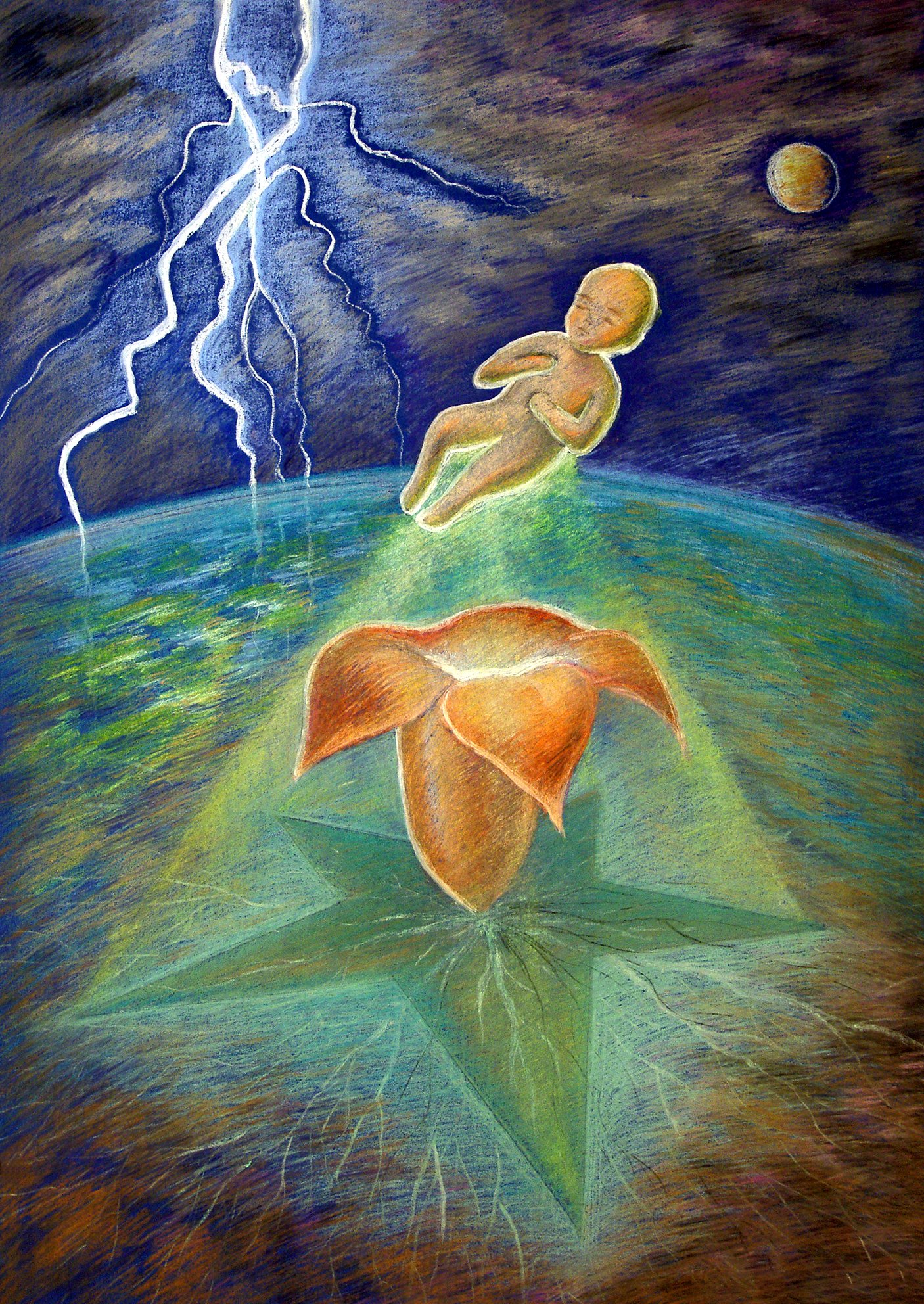
Symbolically, this man died and was reborn. In him a material, sensual, limited and selfish man died, and a new and spiritual person was born. This new spiritual man is still an infant. But he is growing and gaining strength. The main thing has happened – the Giver of Life has reconnected with his Creation, and this relationship will never be interrupted. This is the birth of God in man, that very “Christ in the heart”, that Angelus wrote about.
A person with this kind of mystical experience does not need proof of the existence of Christ, does not need miracles, does not need a sermon. He has experienced a miracle himself, and it has opened his spiritual eyes. He cannot be misled by any external authority anymore, because Christ inside is his sole authority. He reads the scriptures, and they no longer seem to be a collection of obscure rules to him. He himself is now able to explain to others what is meant by “seek and ye shall find.” He knows that the truth opens itself to the persistent, and not to the lazy and easily disappointed. He knows from his own experience that his conscious has to know its humble place in the world hierarchy. He knows that this is the only position that is possible in a dialogue with the supreme force, and it is beautifully expressed in the following lines of the Bible: “Blessed are the poor in spirit, for theirs is the kingdom of heaven “. The convert understands that he is a creation and therefore gives his will to the Creator, because only the Creator knows what is best for man. And that’s why “Thy will be done.”
You say that the mystical experiences of this kind are rare. That too few are being converted. It’s true. It is also true that it’s impossible to artificially induce such experiences. They happen to a man when he is ready for them. But to prepare oneself for such an experience is in everybody’s power. As Gibran said: “And think not you can direct the course of love, for love, if it finds you worthy, directs your course”.