God is in the rain …
“V for Vendetta”
It’s been raining from mid-May. Almost every day. The earth, the houses, the trees, all became saturated, and about to fall to pieces. The air is heavy and warm. A great time for plants, but the capricious man is already wanting some sun… And among this endless rain and dampness, from the depths of my memory, there emerged a half-forgotten verse:
And Fate will through your fingers leak,
Just like this rain that ended in the morning.
Yes, this is Vladimir Levi! My God, it’s been so long! I instantly remembered the poem in its entirety. “Who’s Levi?”, my English speaking readers might ask me. Psychiatrist, psychologist, writer and poet. For me, he is THE person, one of those who had a formative influence on me.
…I remember very well how in the fourth grade at some point I realized – something went wrong in my life. What was once coming naturally, effortlessly, no longer came at all. The peaceful and smooth flow of life was beginning to bog down noticeably. I often felt miserable. And no wonder why. Just imagine, how could one sit for six hours at school, come home, heat up dinner, then do homework, then run errands for adults? In the meantime, my girlfriends were calling me to go play with them. And I was dying to get back to my favorite book… There was also an interesting program on TV… How could one manage all this, so that in the end everyone would be happy, including myself? Life was getting complicated every minute, more often looking like an avalanche that threatened to swallow me whole, leaving nothing. And I had no idea how to deal with this avalanche…
At that time I was reading voraciously (a thick volume of “Peter the First” by Alexei Tolstoy had been “swallowed” in a couple of days!). I was rummaging through books for hours in the school library, in the town library… I read almost everything, indiscriminately.
One day, going through the books at home, I dug out a little book by an Estonian writer about the regimen of the day and good manners for children. I began to read, and very soon realized that it was just what I needed! The book was easy to understand, it had very thorough descriptions on how to effectively organize a day, how to prioritize, how to combine business with pleasure, as well as how to properly make a bed, how to clean a room, how to behave in society…
With enthusiasm, I started to live by this book. I forced myself to get up early, to do exercises, to air the room, to do homework (difficult assignments first!), and only then would I allow myself to take on a favorite book or to run to play with my friends.
In general, there was nothing unbearably difficult in the new regulations. I just had to follow them from day to day, without departing and going soft. Very soon, this method started to bear fruit: the lessons and assignments had been completed, and there was still time for games and reading. The avalanche started to recede. And the bad mood was gone…
I spoke about this magical book with my teacher, and she asked me to bring her the book to read. Alas, the book was never returned to me. But by that time it was no longer needed, I had already learned to apply its basic rules. This was the way self-discipline entered my life…
Another episode in this subject. As a child I hated to clean our apartment – there was too much bulky furniture and too many corners that were hard to reach. Conscientious, quality mopping and dusting took three or four hours. Instead I would love to get into the armchair with a book in one hand and a sandwich in another. Sometimes I did it. But soon I would start feeling remorse. Heavy-hearted, I once again would take the hated rag and helplessly resume cleaning. I was trying to speed up the process, but the quality would inevitably suffer…
Once, in the midst of this struggle with myself, I suddenly remembered summer camp. There, too, they demanded that the floors and the furniture be cleaned nicely and in time. But there it was absolutely impossible to dawdle. Because a committee would come to check the surfaces with a cotton swab. I suddenly thought: imagine, if this committee with a cotton swab would come to our apartment… Hmm. Ironically, this idea worked, and I did a good job cleaning the apartment. Next time again I remembered the committee, and again it worked. After the hundred and first time, I didn’t think about the committee; there was a skill to do the cleaning quickly and efficiently. And I even enjoyed it. (Psychologists may say: the external authority had turned into the inner conviction).
Maybe someone will think: what petty matters she is writing about, we’ve all been through that and somehow learned to cope with the requirements of life. And whoever really thinks so, should not read further.
As an ambitious and curious person, I have always wondered about “how.” How to turn geometry, in which I didn’t know a damn thing, into a favorite subject? Or how to live with the fact that a loved one will never fall in love with me? In search of answers to these questions, I moved groping in the dark, constantly making mistakes, suffering and getting disappointed. There were achievements (as a matter of fact, all of the above are examples of such), but then I did not view them as achievements.
Levi was the first person who shed light on my suffering. He clearly and accurately explained why and where my suffering was stemming from and what to do with it. With his help, in the chaos of my universe there began to emerge Structure. The secret is not only in his “psycho technics”* (although for a young man, perhaps, that’s the only catchy thing). As a true teacher, Levi INSPIRES. He talks to you and mobilizes your potential. He says, “It’s you. You can.” That’s it.
Today, remembering my childhood, I think that my early experiments in self-education were bringing me back to myself. Figuratively speaking, they opposed the centrifugal forces of the “avalanche”, converting them into the centripetal movement toward myself. In the most general sense, they strengthened my self-confidence, gave me the understanding that I am not a helpless and passive victim of circumstances, but the agent who changes the world. And it’s not that I did not have enough confidence, not at all. I think I was born with strong confidence and with the knowledge of self-worth. It was not acquired, it was a gift. I never had any need to prove that I have the right to exist. Neither special deeds, nor particular behavior were necessary to prove that. But throughout my life, I have been observing how the outside world was trying if not to destroy, then at least to substantially shatter this confidence. And as soon as confidence is shattered, a person loses his basis, he ceases to be himself, and he can be easily swept away by the “avalanche”, with which I had struggled in my childhood.
Why do I love Levi? Because he came to exactly the same conclusion as I did – it all depends on you. When you discover innermost insights in the other, then you feel an incredibly strong sense of spiritual togetherness. Jung wrote about it: “It is as if you meet your own father in a long journey.”
As for Levi’s poems, to me they always seemed to be written by a different man. Is it possible to be a logical, practical, witty person and yet at the same time to be a poet? A true poet is always from another world. He’s an alien. He lives in different rhythms and different meanings, he’s here to tell us the Joyful News. As Schopenhauer wrote, one can be a great citizen, but not at the same time a genius. A true poet is always a genius, in my opinion. Levi strangely combines practical rationality with an other-worldly stroke of genius. Maybe this is another secret of his extraordinary appeal.
I re-read Levi’s poems, and again they have bewitched me. So much that there was a burning desire to translate them into English. After all, my dear English readers know nothing about them at all! I was surprised to note that the translation was, in general, not so difficult. It was very exciting, but not difficult.
So, here is Levi’s poem:
Rain
As life, eventually this rain will end,
And our souls with their trampled grounds,
All pitted deeply, fractured, worn and bent,
In the primeval chaos will be drowned.
There in the dark the everlasting stream
Floats predecessors’ shadows to their limits,
And clouds thrash around as feral beasts
Caressed by hands that no one witnessed.
And all this rain, insane, inexorable rain,
Still feeding earth which is already humid,
Becomes prophetic as the artist’s pain
Who’s giving birth to a living spirit.
And our voices are swept away by night…
The cry of memory blends with the distance,
With silence, and with all that one cannot
Surmount by revolt, or by consistence…
Face buried in your hands, you will
Forget yourself in an elusive yearning,
and Fate will through your fingers leak,
Just like this rain that ended in the morning.
*Translated from the Russian “psychotechnika”, Levi’s coined expression for “psychological technique” facilitating self-motivation and/or behavioral modification.
Photo courtesy of George Hodan.
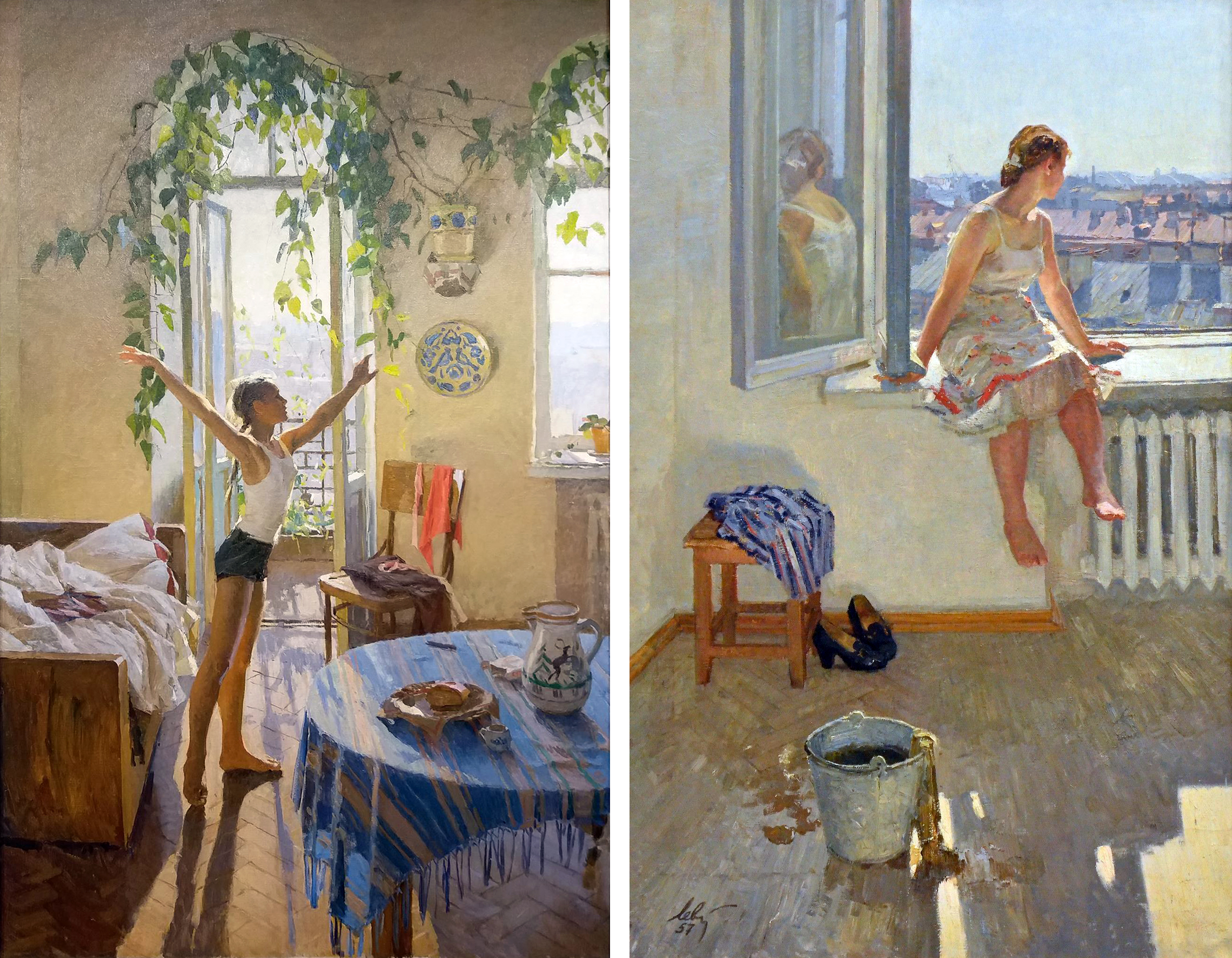
Painting “Morning” by T. Yablonskaya.
Painting “Warm Day” by A. Levitin.